Octordle Winning Strategies: Expert Tips to Master the 8-Word Challenge


Conquering Octordle requires more than vocabulary—it demands strategic thinking, pattern recognition, and efficient resource management. While solving eight five-letter words simultaneously might seem overwhelming at first, implementing the right strategies transforms Octordle from frustrating to deeply satisfying. This comprehensive guide reveals battle-tested tactics used by top players to consistently achieve impressive scores.
Understanding the Octordle Challenge
Before diving into strategies, it’s essential to understand what makes Octordle uniquely challenging. Unlike its predecessor Wordle, Octordle presents:
- Eight simultaneous puzzles requiring divided attention
- 13 total guesses that must efficiently serve all grids
- Complex information management across multiple boards
- Time pressure (especially in timed modes)
- Strategic prioritization of which grids to solve first
Success requires balancing exploration (testing new letters) with exploitation (solving identified patterns), all while managing limited guesses across eight independent grids.
Start applying these strategies at octordlegame.net today.
Core Strategy #1: The Information Maximization Approach
Principle: Extract Maximum Value from Every Guess
Your first 3-4 guesses should prioritize information gathering over solving individual words. This means:
Do:
- Use words with diverse, common letters
- Test all five vowels within first 2-3 guesses
- Avoid repeating letters in early guesses
- Choose words that test different letter positions
Don’t:
- Try to solve specific grids before gathering sufficient data
- Repeat letters you’ve already tested
- Use obscure words with rare letters
- Focus exclusively on one or two grids
Implementation
Guess 1: SLATE (tests S, L, A, T, E)
Guess 2: CORNY (tests C, O, R, N, Y)
Guess 3: HUMID (tests H, U, M, I, D)
After these three words, you’ve tested 15 unique letters, covering approximately 75% of commonly used letters. Most grids will show multiple yellow or green letters, giving you clear paths forward.
Core Strategy #2: The Grid Prioritization System
Identifying Which Grids to Solve First
Not all grids are created equal. After your information-gathering phase, categorize grids:
Priority 1 – Easy Grids (Solve These First):
- 3+ green letters identified
- Clear letter patterns (common endings like -ER, -ED, -LY)
- Few viable word options remaining
Priority 2 – Medium Grids (Solve After Easy Ones):
- 2 green letters + 2-3 yellow letters
- Some pattern clarity but multiple possibilities
- Moderate difficulty
Priority 3 – Hard Grids (Save for Last):
- Mostly yellow letters, few greens
- Unclear patterns
- Many potential word options
Why This Works: Solving easier grids first builds momentum and reduces cognitive load. Each solved grid means one less puzzle competing for your attention, allowing better focus on remaining challenges.
The 3-3-2 Rule
A powerful guideline for managing guesses:
- Use 3 guesses for information gathering
- Allocate 3 guesses for solving easy grids (roughly one guess per easy word)
- Reserve 2 guesses per remaining grid
This distribution prevents the common mistake of using too many guesses early and having insufficient attempts for final grids.
Check today’s puzzle solutions in our Octordle daily answers section.
Core Strategy #3: The Pattern Recognition Method
Common Five-Letter Word Patterns
Recognizing patterns accelerates solving dramatically:
Common Endings:
- -TION (though typically 5+ letters, look for -IENT)
- -NESS (BLESS, CHESS)
- -IGHT (FIGHT, LIGHT, MIGHT)
- -OUND (BOUND, FOUND, MOUND, ROUND, SOUND, WOUND)
- -ATCH (BATCH, CATCH, HATCH, MATCH, PATCH, WATCH)
Common Letter Combinations:
- TH (THINK, THOSE, THREE)
- CH (CHAIR, CHESS, CHEAP)
- SH (SHADE, SHAKE, SHARP, SHELL)
- ST (START, STARE, STERN, STILL, STORM)
Double Letter Words: When stuck with 3-4 letters identified, consider double letters:
- SPEED, SPILL, SPELL
- GLASS, GRASS, GROSS
- HAPPY, PUPPY, FUZZY
- SKILL, STILL, DRILL
Pattern-Based Solving Example
Grid Shows: _ R E E _ (Green: R in position 2, E in positions 3-4)
Pattern Analysis:
- Double E is uncommon but exists
- -REE- pattern suggests words like GREET, CREEK, BREED
- Position 2 R limits options significantly
Likely Words: GREED, BREED, CREED, FREED, GREET, CREEK
Testing one of these high-probability words often solves the grid immediately.
Core Strategy #4: Keyboard Color Coordination Mastery
Leveraging Octordle’s Visual Interface
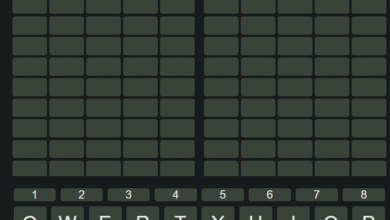
Octordle’s keyboard divides into eight colored sections corresponding to each grid. This powerful feature helps track letter status across multiple puzzles.
How to Use It:
- Before each guess, scan the keyboard to see which letters are confirmed/eliminated for each grid
- After each guess, check how colors change across different keyboard sections
- Identify patterns: Letters gray in 6 grids but yellow/green in 2 suggest where to focus
Pro Tip: Some players mentally group grids into pairs or quads, making color tracking more manageable than monitoring all eight individually.
Core Strategy #5: The Anti-Tunnel Vision Technique
Avoiding the Biggest Octordle Mistake
Tunnel vision—obsessing over one difficult grid—is the primary reason players fail. You spend 5-6 guesses trying to solve a tricky word while easier grids remain unsolved.
Prevention Tactics:
Rule 1: The Two-Guess Limit
If you can’t solve a grid within two dedicated guesses, move to a different grid. Return later with fresh perspective.
Rule 2: The 50% Rule
Never spend more than half your remaining guesses on a single grid. If you have 6 guesses left and 4 grids unsolved, allocate maximum 3 guesses to any one grid.
Rule 3: The Fresh Eyes Approach
When stuck, solve 2-3 other grids first. Often, the difficult word becomes obvious when you return with reduced cognitive load.
Advanced Strategy #6: The Guess Efficiency Calculator
Maximizing Information Per Guess
Not all guesses are equal. Some provide information across multiple grids while others only help one or two.
High-Efficiency Guesses:
- Use letters that appear yellow on multiple grids
- Test potential letters for 3+ grids simultaneously
- Choose words that could solve multiple grids at once
Low-Efficiency Guesses:
- Words helping only one grid
- Testing letters already confirmed/eliminated
- Guesses made impulsively without considering all grids
Example Decision:
Scenario: Grid 1 needs testing I/U, Grid 3 needs testing A/O, Grid 5 needs testing E
Option A: Guess QUITE (tests I, U, E—helps 2 grids)
Option B: Guess PIANO (tests I, A, O—helps 3 grids)
Best Choice: PIANO provides broader coverage
Mode-Specific Strategies
Daily Mode Strategy
Objective: Consistent completion with good scores
Approach:
- Use reliable starting words (CRANE, SLATE, STERN)
- Follow the 3-3-2 rule for guess distribution
- Prioritize completing all eight words over achieving lowest score
- Track patterns in daily puzzles (some days favor certain letter types)
See today’s challenge at Octordle game.
Sequence Mode Strategy
Objective: Solve grids sequentially with 15 guesses total
Key Differences:
- You only see one grid at a time
- Must fully solve each before accessing the next
- 15 guesses total provides buffer room
Optimal Approach:
- First grid: Use two information words (AUDIO + STERN)
- Solve first grid using gathered intel (typically 1-2 guesses)
- Subsequent grids: Use one exploratory guess + solve (2 guesses per grid)
- Final grids: You’ll have extensive letter knowledge; solve quickly
Average Distribution: 4 guesses for Grid 1, then 2 guesses per remaining grid = 18 total… but you have letters from previous solves helping you, so actual usage is lower.
Master this mode with our Octordle Sequence guide.
Rescue Mode Strategy
Objective: Complete eight grids with only 9 guesses (4 pre-filled)
Critical Tactics:
- Immediately assess what the four given words revealed
- Identify easiest grids based on pre-filled information
- Solve those first (likely 2-3 easy grids from starter words)
- Use remaining guesses efficiently on harder grids
- Accept calculated risks—you might need to guess with less certainty
Mindset: Rescue mode requires aggressive solving. Don’t wait for perfect information; make educated guesses based on partial data.
Extreme Mode Strategy
Objective: Solve eight words with only 12 guesses
Approach Modifications:
- Reduce information phase to 2 guesses maximum
- Use two-word starting combos that test 10 letters (SLATE + CORNY)
- Solve easier grids very quickly to create breathing room
- Accept higher risk tolerance—sometimes you must guess with limited data
- Leverage patterns heavily—rely on common word structures
Key Principle: Efficiency over perfection. You don’t have luxury of thoroughly exploring every grid.
Mental Game Strategies
Managing Cognitive Load
Problem: Eight simultaneous puzzles overwhelm working memory
Solutions:
1. Chunking: Group grids into pairs or quads (1-2, 3-4, 5-6, 7-8)
2. External Aids: Some players briefly note key information on paper
3. Sequential Focus: After information gathering, solve one grid at a time
4. Visual Scanning: Develop systematic scan pattern (top-left to bottom-right)
Maintaining Focus
Problem: Long games cause attention to wander
Solutions:
1. Time Limits: Set personal time constraints (complete within 10 minutes)
2. Breaks: If struggling, take 30-second break between guesses
3. Routine: Develop consistent approach that becomes automatic
4. Environment: Play in quiet space with minimal distractions
Data-Driven Strategy Optimization
Tracking Your Performance
Serious players track metrics:
- Average guesses per game
- Percentage of “no clock” completions (all words in ≤10 guesses)
- Success rate by starting word
- Average time per game
- Most challenging grid positions
Tools: Spreadsheet or notes app with date, starting words, guesses used, result
After 50+ games, patterns emerge revealing:
- Which starting words work best for you
- Common mistakes you make
- Optimal guess distribution for your style
- Grid positions where you struggle
Expert-Level Tactics
The Elimination Game
Advanced players focus on what words CAN’T be:
Instead of thinking “what word could this be?”, think “what words can I eliminate?”
Example: Grid shows _ A _ E _ with R, S, T, N eliminated
Many words fit: BAKED, CAGED, DAZED, FADED, GAMED, etc.
Elimination approach: Consider which words share patterns:
- -AKED words: BAKED, CAKED, NAKED, RAKED (R eliminated → not RAKED)
- -ADED words: FADED, JADED, WADED
- -AGED words: CAGED, PAGED, RAGED (R eliminated → not RAGED)
Choose a guess that tests distinctive letters: BAKED (tests B, K)
If BAKED isn’t correct, you’ve eliminated all -AKED words. Next try FADED to test -ADED pattern.
The Sacrifice Guess
Sometimes using a guess that won’t solve any grid but tests crucial letters across multiple grids is worth it.
Example: Six grids remain unsolved, each missing different letters. One strategic “sacrifice” guess testing those six letters might provide enough information to solve multiple grids with subsequent guesses.
When to Use: Mid-game when you have adequate guesses remaining and need clarity across multiple grids
Common Strategy Mistakes
Mistake 1: Solving Grids in Numerical Order
Why It’s Wrong: Grid 1 might be hardest while Grid 6 is easiest
Fix: Always prioritize by difficulty, not position
Mistake 2: Reusing Eliminated Letters
Why It’s Wrong: Wastes guesses on impossible words
Fix: Check keyboard colors before every guess
Mistake 3: Not Adapting Mid-Game
Why It’s Wrong: Rigid strategies fail when puzzles vary
Fix: Reassess after every 2-3 guesses
Mistake 4: Speed Over Accuracy
Why It’s Wrong: Rushed guesses miss obvious solutions
Fix: Take 10 seconds to think before each guess
Building Your Personal Strategy
Week 1-2: Master information gathering
Week 3-4: Practice grid prioritization
Week 5-6: Develop pattern recognition
Week 7-8: Refine your personal approach
Week 9+: Experiment with advanced tactics
Resources for Continued Improvement
- Word Lists: Study common five-letter words
- Pattern Libraries: Familiarize yourself with frequent patterns
- Community: Join forums to discuss strategies
- Daily Practice: Consistency builds intuition
For comprehensive word frequency data, check WordFrequency.info.
Final Thoughts: Mastering Octordle
Becoming proficient at Octordle requires:
- Strategic Framework: Know your approach before starting
- Pattern Knowledge: Recognize common word structures
- Adaptive Thinking: Adjust tactics based on puzzle complexity
- Efficient Resource Management: Maximize information from each guess
- Consistent Practice: Daily play builds intuition
The strategies outlined here provide a foundation, but the best Octordle players develop personalized approaches through experience. Start with these proven tactics, track your results, and refine your method over time.
Remember: Octordle is as much about strategy as vocabulary. Two players with identical vocabularies will achieve vastly different scores based on their strategic approach. Master the strategies in this guide, and you’ll join the ranks of Octordle’s top solvers.
Ready to implement these winning strategies? Play Octordle now at octordlegame.net and watch your performance soar!